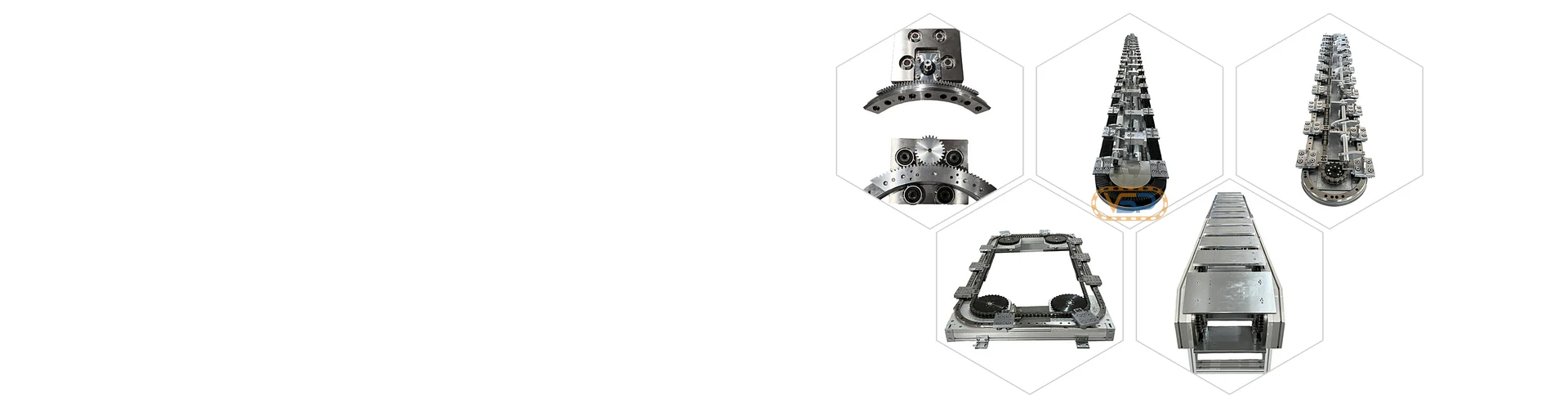
Ring Rail Selection Guide
Select the driving mode and guide rail form according to the working conditions to avoid only looking at the guide rail model and ignoring the selection deviation of the matching between the drive and the slider.
1. Decide on three things first, then talk about the model
The selection sequence is recommended to be fixed as: trajectory form → beat and load → accuracy and environment. If the order is reversed, it is easy to change the plan repeatedly.
- trajectory form: Ellipse, rectangle, or just an arc? This determines the number of arc segments and the length of straight line segments.
- Beat and load: The load of a single station must include the fixture, and the cycle time must include the acceleration and deceleration time. It cannot be estimated based on uniform speed only.
- Accuracy and environment: Repeatable positioning accuracy requirements, as well as environmental constraints such as cleanliness, temperature, dust, and explosion protection.
2. How to choose among the four driving modes
| Drive mode |
load |
Tempo / Beat |
Accuracy features |
environmental adaptability |
Typical scenario |
| chain type |
High, suitable for heavy loads and large workstations |
Medium and low speed |
Indexing relies on mechanical limit/pin positioning |
General industrial environment; regular lubrication required |
Automobile new energy, heavy-duty assembly |
| Belt type (synchronous belt) |
Medium and light load |
high speed |
Depends on servo and belt tensioning |
Cleaner and less noisy |
3C electronics, light load high-speed assembly |
| cam linkage |
Medium load |
high tempo |
High indexing accuracy and good repeatability |
General industrial environment |
Precision indexing and multi-station synchronization |
| Magnetic levitation conveyors |
Light to medium load |
High speed and flexible scheduling |
Contactless, frictionless, programmable |
Ultra clean, low maintenance |
Medical equipment and semiconductor clean workshop |
The above table is a comparison of the suitability of working conditions. The specific load, rhythm and accuracy values must be confirmed after calculation according to the plan.
3. Guide rail forms: V-shaped, T-shaped and arc guide rails
- V-shaped guide rail (V30 / V44 arc guide rail): The roller rolls along the V surface, has a certain self-centering ability, and has good dust tolerance. It is suitable for general industrial environments and arc-shaped tracks.
- T-shaped guide rail: The cross-section is a T-shaped structure with good rigidity, suitable for occasions that require higher processing accuracy and rigidity.
- Arc guide rail components: Used to form a circular or arc trajectory, and can be supplied separately for replacement; when replacing, please check the arc radius, cross-sectional form and slider specifications.
4. List of parameters required for model selection
- Number of workstations and spacing between workstations
- Beat requirement or line speed
- Single station load (Weight including fixture)
- Arc radius and straight line length
- Repeat positioning accuracy requirements
- Installation space restrictions (length, width, height)
- Usage environment: cleanliness, temperature, dust, explosion-proof, etc.
5. Common misunderstandings in model selection
- Only select according to the guide rail model, ignoring the matching of the driving method and the slider
- The load only counts the workpiece and the fixture is omitted, resulting in insufficient load-bearing capacity after operation.
- If the arc radius is too small, the stress on the roller will deteriorate and the service life will be reduced.
- The beat is estimated based on the ideal value of uniform speed, and no acceleration and deceleration time is reserved.
- Clean environment chooses a chain solution that requires lubrication
6. Frequently Asked Questions
- How to choose between elliptical ring guide rail and rectangular ring guide rail?
- Look at the workstation layout and venue. The arc section of the elliptical annular guide rail has smooth transition and small steering impact, and is suitable for situations where workstations are distributed along the long side and stability is pursued; the linear section of the rectangular annular guide rail has high utilization rate and can accommodate more workstations in the same area. The small radius plan needs to calculate the stress separately.
- The beat cannot go up. Is it a rail problem or a drive problem?
- Most of them are stuck in the drive and control, not the guide rail body. It is recommended to first calculate the acceleration and deceleration time, indexing positioning waiting time, and whether the fixture weight exceeds the original estimate.
- Which drive method should I choose for a clean workshop?
- Priority is given to magnetic levitation conveyor lines, followed by belt conveyors. The chain type requires lubrication and contains wear debris, so it is generally not recommended for use in clean environments.
- Can I customize it with drawings and samples?
- Yes. Supports non-standard design and manufacturing based on drawings or samples. The plan and delivery date must be evaluated after confirming the drawings and working conditions.