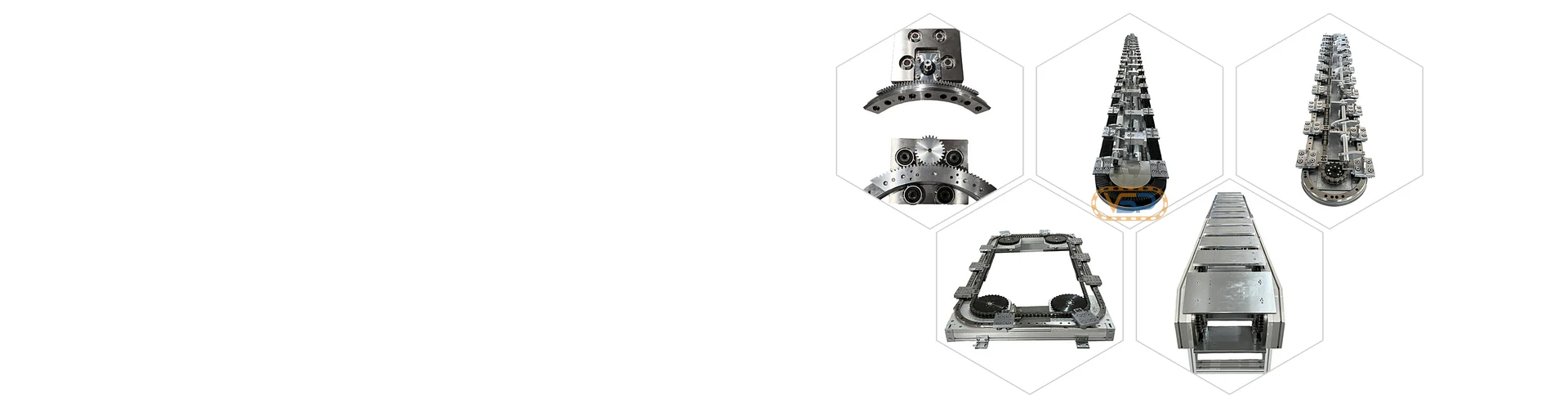
On automated production lines, workpieces need to be automatically transferred between different stations, and these tasks are completed by various conveyor lines. The circular assembly line is a new type of equipment. It is composed of linear guide rails + arc guide rails + positioning system + auxiliary materials. It is used in the electronics and electrical industries as an automatic punching machine.
On automated production lines, workpieces need to be automatically transferred between different stations, and these tasks are completed by various conveyor lines. The circular assembly line is a new type of equipment, which is composed of linear guide rails + arc guide rails + positioning system + auxiliary materials. It is used in the electronics and electrical industries as automatic stamping lines and assembly lines. This production method connects various work stations together as required to minimize the distance between work stations. It has a compact structure, high positioning accuracy and fast speed. So what are the structural characteristics of the ring assembly line?
In automated production lines, workpieces need to be automatically transferred between different special machines. These tasks are completed by various conveyor lines. The most typical ones in engineering include belt conveyor lines, chain (chain plate) conveyor lines, roller conveyor lines, turntables, circular guide rails, etc. The slides on the circular guide rails are connected in series through synchronous belts to form a cyclic automated production line.
The belt and the slide are fixed by two screws in the horizontal direction. When passing the synchronous pulley, the synchronous belt will not lean outward and can transmit a large driving force. Therefore, this kind of connection mechanism can achieve a higher linear speed. The synchronous pulley also needs to be machined with corresponding grooves to facilitate the meshing of the pulley and the belt. The movement distance of the centripetal movement of the slide on the arc section needs to be taken into account to deepen the groove.
The movement of the slide on the guide rail has only one axial degree of freedom and moves along a predetermined trajectory; when multiple slides are installed on a set of annular guide rails, since these slides only have one axial degree of freedom and are in the same axial direction, these slides can be connected together through a synchronous belt to form a closed slide chain. With the addition of a drive system, multiple workstations can rotate synchronously.

 WhatsApp Business