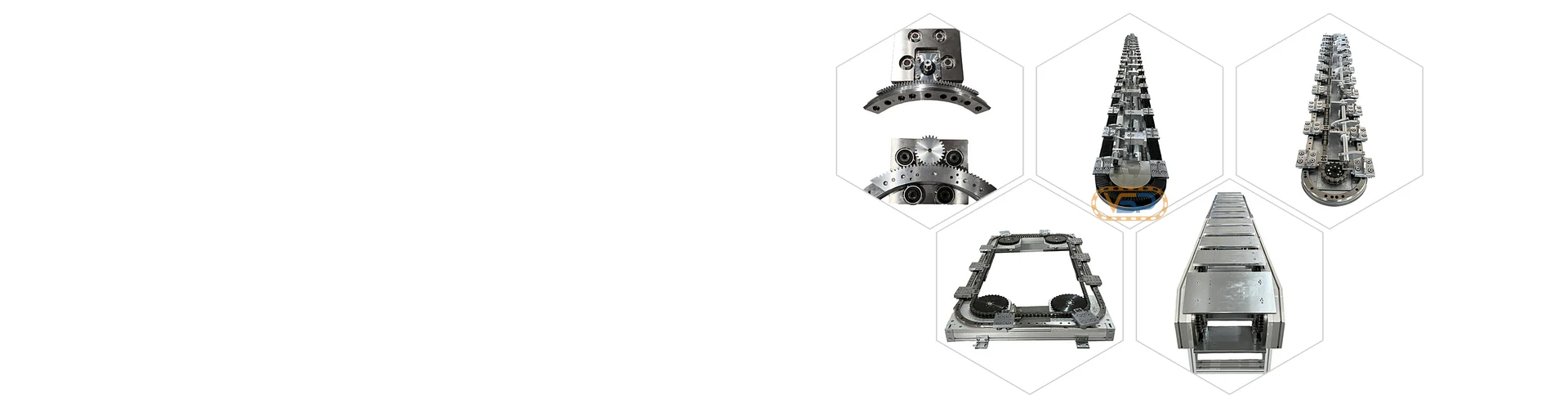
In many applications of industrial automation, linear guide motion is very common, but some applications require arc motion, or two intersecting or parallel linear motions need to be connected through arc motion to achieve seamless connection of linear motion. At this time, you can consider choosing arc guide rails. Curved guide rails are more suitable
In many applications of industrial automation, linear guide motion is very common, but some applications require arc motion, or two intersecting or parallel linear motions need to be connected through arc motion to achieve seamless connection of linear motion. At this time, you can consider choosing arc guide rails. Arc guide rails are more suitable for occasions that require curved motion or arc interpolation, such as robots, aerospace equipment, precision measuring instruments, etc.; they can achieve smooth curved motion and precise arc interpolation, improving the motion performance and positioning accuracy of the equipment. So what are the differences between arc guide rails and linear guide rails?
1. From the perspective of motion trajectory, the linear guide moves linearly driven by the balls. The contact area between the balls and the guide rail groove is small, which makes the surface of the guide rail evenly stressed and has a long life cycle. The curved guide rail achieves movement by rolling balls on the curved surface of the guide rail. The curved surface of the guide rail bears a larger contact area, so the load-bearing capacity is higher than that of the linear guide rail.
2. From a structural point of view, linear guide rails have a straight shape and play a role in positioning, supporting and guiding the movement of machinery and equipment. Arc guide rail is a special circular structure that is widely used in hardware, automation and precision mechanical equipment, and can maintain the axis position of relative motion unchanged.
3. From an application perspective, linear guides are widely used in CNC machine tools, semiconductor equipment, medical equipment and other fields due to their linear motion characteristics. They can provide high-precision, high-rigidity and low-friction motion control and are suitable for high-speed, high-precision linear motion requirements.

 WhatsApp Business