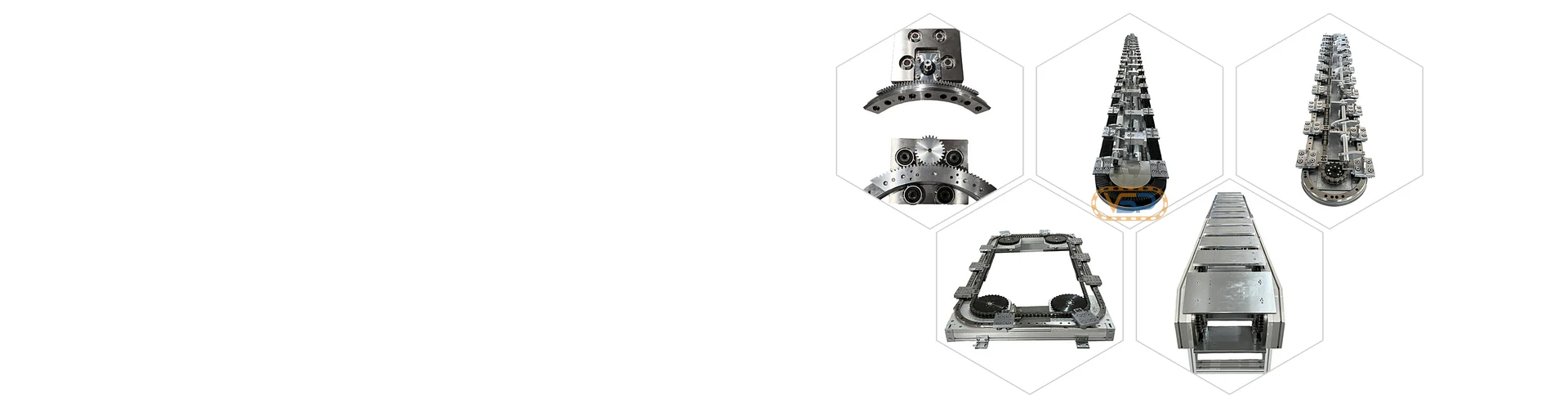
The layout form determines the overall dimensions and workstation layout capabilities of the equipment, and is the first item that must be confirmed during the site planning stage. The following four are the most common loop layouts in projects.
It consists of two straight lines and two semicircular arcs, which is the most common form. The long straight section is used to arrange work stations, and the arcs at both ends complete the side-changing rotation. Operators can load and unload materials on the same side, which is ergonomically friendly. It is suitable for production lines with a medium number of workstations and a long site.
It consists of four straight line segments and four corner arc segments. The total length of the straight line segments is longer, more workstations can be arranged, the four-corner rotation radius is relatively smaller, and the space utilization rate is high. It is suitable for equipment with a large number of workstations, a nearly square site, and a regular appearance.
The whole is in the shape of a ring and has a compact structure, which is suitable for occasions with a small number of workstations and limited space. Due to the large proportion of arcs, the slide runs for a long time in the curve, requiring higher cornering speed and stability. The choice of turning diameter is particularly critical.
The circulation plane is perpendicular to the ground, which can significantly save floor area. The vertical space is used to arrange work stations. It is common in small assembly and testing equipment that requires multi-layer operations or upper and lower layer reflow. The requirements for frame rigidity and installation reference plane are higher.
On the premise of meeting the usage requirements, the turning diameter should be as large as possible to avoid using arc guide rails that are too small. The reason is very straightforward: the smaller the arc diameter, the faster the linear speed of the slide when cornering, the greater the centrifugal force, and the more obvious the collision between the roller and the guide rail, which will increase the operating noise and intensify wear in the long term. Therefore, when the site allows, priority should be given to enlarging the turning radius; when the site is limited and forced to use a small diameter, the operating speed should be simultaneously reduced and positioning and buffer design should be strengthened.
The confirmation includes: the maximum allowable external dimensions of the equipment, the loading and unloading orientation, whether the work station is in a straight section or an arc section, whether intermediate support is required, and access to maintenance channels. It is recommended to make a layout sketch first to mark key dimensions before entering into detailed design.
Description:This article is a general summary of the layout form. The specific size and radius of rotation need to be determined based on the actual working conditions and site, and are subject to technical confirmation.


Precision conveying systems · Products and service
Products
Chain-driven ring guidesBelt-driven ring guidesPrecision link conveyorsCurved and linear guide componentsMagnetic levitation conveyorsCam-link ring guidesAbout us
Company profileOur facilitiesCertifications VideosApplicationsApplications
Automotive & new energy Precision electronics assembly Consumer electronicsMedical devicesNew energyPrecision dispensingNews
Company news Industry news NewsContact us
Contact details WhatsApp Business
Contact details+86 18912659251
Links: