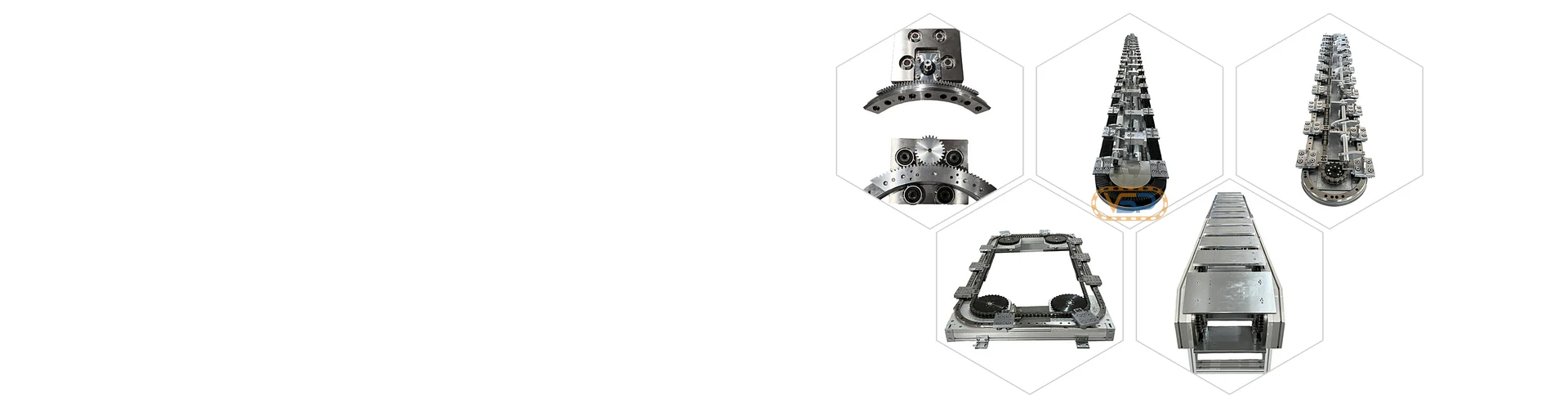
Ring guide rails are non-standard and highly customized cyclic conveying components. Whether the selection is accurate directly determines the rhythm, positioning accuracy and operating noise of the subsequent production line. The following steps are sorted out in the order of engineering practice for reference in the equipment selection stage.
First solidify the process input: how many workstations are needed, how much a single workstation can carry, the required production cycle time (seconds/piece), the positioning accuracy requirements when the workstation stops, and the on-site environment (whether there is dust, oil stains, cleanliness requirements, temperature range). These items are the input benchmarks for all subsequent selection calculations. Missing any one of them will lead to repeated plans.
Common forms include ellipses, rectangular rings, circular revolutions, and special-shaped layouts that combine straight segments and arc segments. The long straight section is usually used to arrange the work station, and the arc section is used for side rotation. The layout form determines the ratio of linear guide rails and arc guide rails, and also determines whether the overall dimensions of the equipment can be placed in the reserved space.
T rail and V rail are two common types of cross sections. The V-shaped cross-section rollers are in V-shaped contact with the guide rails and have certain self-centering characteristics. They are often used in situations where lateral restraint is required. The T-shaped cross-section has a compact structure and is suitable for models with limited space. The specific selection needs to be determined based on the load-bearing direction, lateral force and installation datum plane.
The driving mode determines the speed, noise and maintenance characteristics of the system. There are four common types: synchronous belt drive, chain drive, cam link drive and magnetic levitation drive. Each has its own applicable boundaries. For details, see the special article "How to Choose the Ring Guide Driving Mode" for comparison.
The number of slide seats is usually consistent with the number of stations, and the arc segment specifications need to match the guide rail section and turning radius. Among the arc guide rail components, different specifications correspond to different load-bearing and turning radius ranges. When selecting, they should be in the same series as the main rail to avoid mixed installation leading to operational interference.
To achieve repeated positioning of the workstation, the circular guide rail system usually needs to be equipped with a secondary positioning mechanism. For occasions with strict noise requirements, electric push type (servo) positioning is preferred. The operating noise is mainly slight servo motor sound. If conventional pneumatic noise is acceptable, cylinder type positioning can be used, and the impact noise can be suppressed by reducing the air pressure and appropriately extending the positioning action time.
It is recommended that the above items be solidified into a one-page technical confirmation form: number of stations, pitch, single station load, cycle time, positioning method, driving method, guide rail section and specifications, external dimension constraints, and environmental conditions. This list is both the basis for internal reviews and a complete input for communication with manufacturers, which can significantly reduce the number of round-trip confirmations.
Description:This article is a compilation of the general selection process. The specific load capacity, accuracy and cycle time values need to be evaluated based on actual working conditions and are subject to technical confirmation.


Precision conveying systems · Products and service
Products
Chain-driven ring guidesBelt-driven ring guidesPrecision link conveyorsCurved and linear guide componentsMagnetic levitation conveyorsCam-link ring guidesAbout us
Company profileOur facilitiesCertifications VideosApplicationsApplications
Automotive & new energy Precision electronics assembly Consumer electronicsMedical devicesNew energyPrecision dispensingNews
Company news Industry news NewsContact us
Contact details WhatsApp Business
Contact details+86 18912659251
Links: