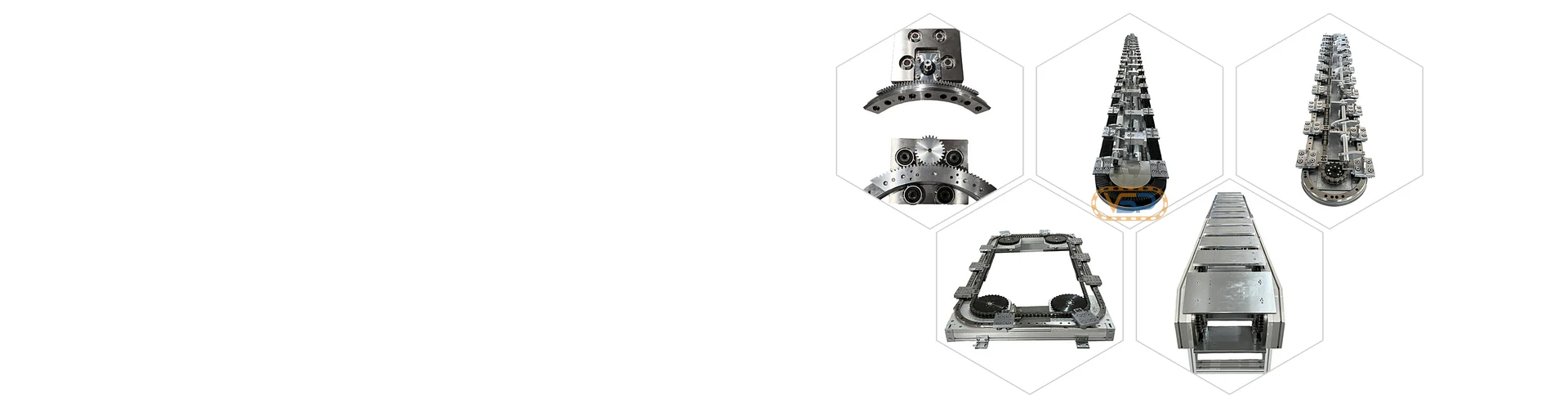
The driving method is the most underestimated aspect of ring rail selection. For the same track system, if the driver is replaced, the noise, speed limit, maintenance cycle and overall cost may be completely different. The following is a horizontal comparison of four common types of drivers.
Synchronous belt drive runs smoothly and makes relatively little noise. It is a common solution for medium and low speed cyclic conveying. The belt body has a certain degree of elasticity, which can absorb part of the impact and has a small impact on the positioning mechanism; no lubrication is required, and daily maintenance is mainly based on tension inspection and belt body wear inspection. It is suitable for electronic and medical production lines with moderate rhythm and high cleanliness requirements.
Chain drive has strong load-bearing capacity and good durability, and is suitable for working conditions with high load or long service life requirements. Compared with synchronous belts, the operating noise of chain drive is slightly higher, so it needs regular maintenance and proper lubricating grease. When running at low speed, the noise of high-quality chain can be controlled within an acceptable range. If the working speed is not high and the load is large, a chain is often a safer choice.
The cam linkage structure controls the acceleration and deceleration process of the slide through the cam curve, which can achieve start and stop close to a sinusoidal pattern. It has a strong sense of mechanical rhythm and good repeatability, and is suitable for multi-station assembly scenarios that have clear requirements for motion patterns. Its acceleration and deceleration characteristics are determined by the cam curve. It is a highly specialized solution and is suitable for batch production lines with a fixed rhythm.
The magnetic levitation drive drives the slide in a non-contact manner, with minimal friction and wear, low noise, and high cleanliness. Each slide can be independently controlled and has the highest flexibility. It is suitable for scenarios that require high precision, high cleanliness or high flexibility in model replacement. The initial investment and control system complexity are also relatively high.
| Comparative item | timing belt | chain | cam linkage | Maglev |
|---|---|---|---|---|
| operating noise | lower | in | in | low |
| Carrying capacity | in | higher | in | Depends on specifications |
| Speed characteristics | Smooth at medium to high speed | More stable at low speed | fixed beat | High flexibility |
| maintenance requirements | Check tensioning and wear | Regular lubrication and maintenance | Cam pair inspection | low |
| clean fit | better | General (requires lubrication) | Average | Excellent |
| Flexible changeover | in | in | low | high |
Give priority to the four categories of "load - rhythm - noise - cleanliness": high load and slow rhythm, tend to the chain; noise-sensitive and moderate rhythm, tend to the synchronous belt; batch special machines with a solid rhythm, tend to the cam connecting rod; high precision, high cleanliness or need frequent model changes, evaluate the magnetic levitation plan.
Description:The table is a qualitative comparison. The specific speed, load-bearing and noise values must be determined based on specifications and actual working conditions, and are subject to technical confirmation.


Precision conveying systems · Products and service
Products
Chain-driven ring guidesBelt-driven ring guidesPrecision link conveyorsCurved and linear guide componentsMagnetic levitation conveyorsCam-link ring guidesAbout us
Company profileOur facilitiesCertifications VideosApplicationsApplications
Automotive & new energy Precision electronics assembly Consumer electronicsMedical devicesNew energyPrecision dispensingNews
Company news Industry news NewsContact us
Contact details WhatsApp Business
Contact details+86 18912659251
Links: