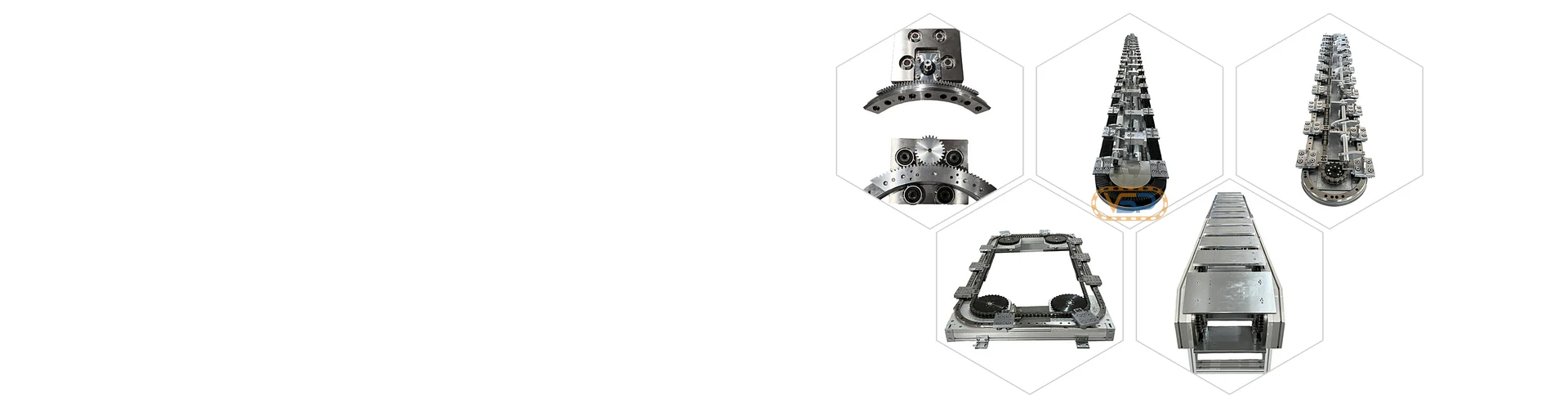
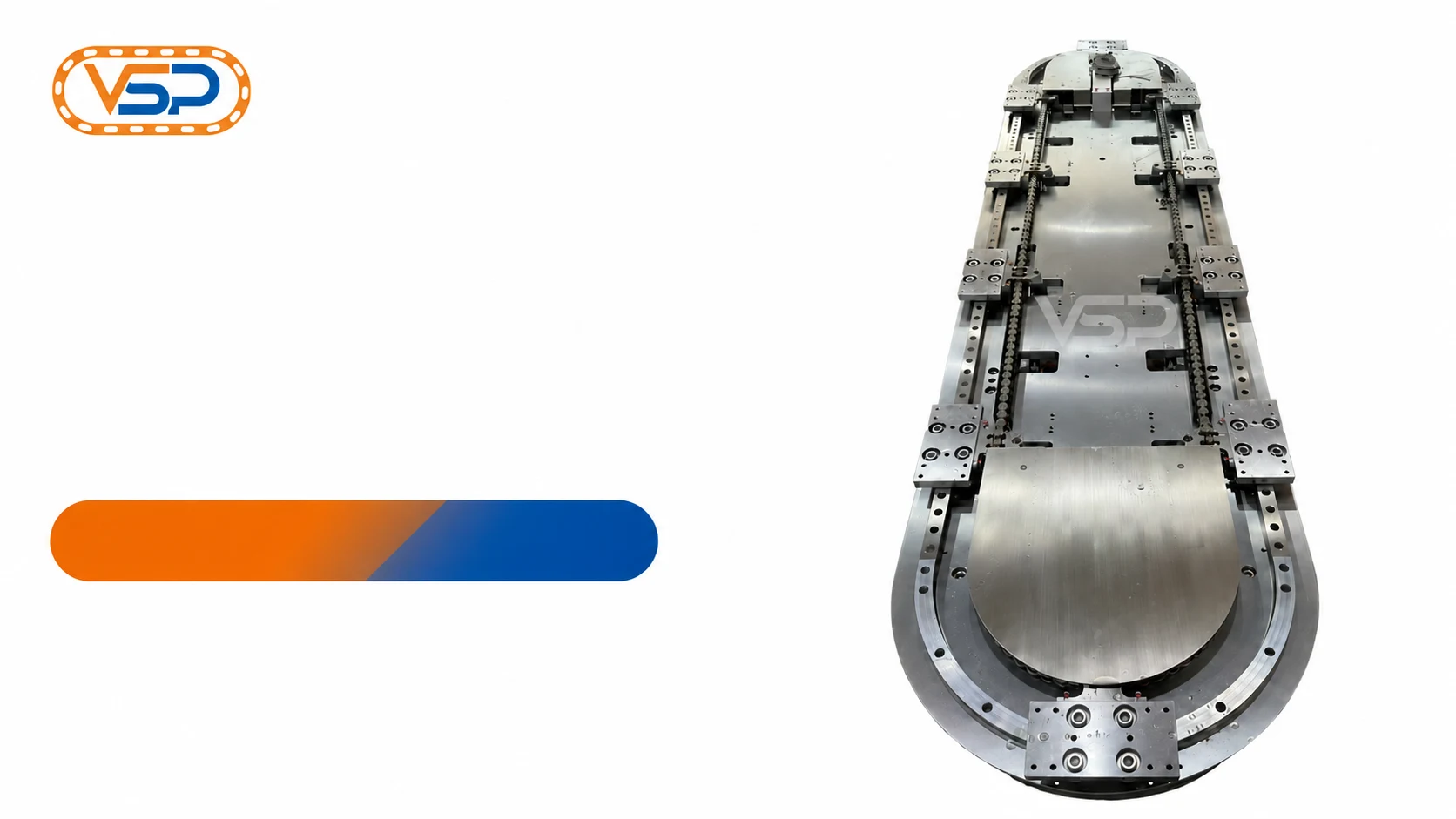
 How many work stations are elliptical ring guides suitable for? How to determine the number of carriages?
The elliptical ring guide is suitable for several work stations, and there is no fixed answer. The number of workstations is determined by the process steps, and the number of slides must simultaneously meet the cycle time, tooling size, dwell time and return space. Estimating only based on the length of the guide rail or the location that can be placed on site will often lead to crowded work stations, interference in loading and unloading, or no margin in the return section.
In the planning stage, you can first confirm the "number of workstations" and "number of carriages" separately, and then check them through the layout drawing.
The number of workstations refers to the number of operating positions required for the process, such as loading, assembly, testing, unloading, etc.; the number of slides refers to the number of carriers that actually carry the tooling and circulate on the conveyor line.
In some projects, one station only handles one set of tooling; in other projects, one station needs to process multiple sets of tooling continuously, or keep empty slides in the return section. There is no one-to-one correspondence between the two.
Before determining, the work content and dwell time of each workstation should be listed, as well as whether manual loading and unloading, visual inspection, pressing, or caching are required. Only in this way can we determine which workstations will become cycle bottlenecks.
The goal of cyclic conveying is not to keep the guide rail running at the highest speed, but to complete the action at a set cycle time at each station. When the residence time of a certain station is long, it usually needs to be solved from the overall process arrangement, parallel station or slide circulation method, rather than simply increasing the operating speed.
For example, when the working times of assembly, testing and blanking are inconsistent, you should focus on confirming:
1. Which workstation takes the longest time;
2. Does the carriages need to stay after it is in place?
3. Whether parallel operation of front and rear workstations is allowed;
4. Can the return segment be buffered or returned without load;
5. Will starting, stopping, positioning and loading and unloading take up extra time.
Speed is the operating parameter and takt is the total time required to complete a cycle. The difference between the two can be referred to"How to choose a circular guide rail? Load, Cycle, Layout and Driver Verification Checklist".
When determining the number of slides, you cannot just look at the size of the slide body. What really needs to be reserved is the maximum envelope of tooling, products, fixtures, sensors and cables during operation.
If the distance between adjacent tooling is too small, interference is likely to occur at corners, manual operation areas, or loading and unloading locations. For tooling with extended fixtures, rotating mechanisms or larger products, the distance between the straight line segment and the arc segment should also be checked according to the maximum overall size.
It is recommended to mark the following on the layout diagram:
1. The length, width, height and maximum extension position of the tooling;
2. Minimum safety distance between adjacent slides;
3. Work space for operators, robots or testing equipment;
4. The possible sweep range at the turn;
5. Location of sensors, stops and guards.
The elliptical layout usually consists of two straight process sections and turning sections at both ends. When planning, all space cannot be allocated to work stations. Return travel, loading and unloading, and maintenance also need to be reserved.
Especially for equipment that requires manual picking and placing, robot loading and unloading, or online inspection, it should be confirmed that the operating area will not interfere with the running tooling. Later, reducing the distance between slides to "pack in more stations" will usually increase the difficulty of debugging.
For preliminary selection or layout confirmation, it is recommended to prepare the following information:
1. Process flow: Which work stations are required for loading, assembly, testing, and unloading;
2. cycle time requirements: the action time of each station and whether it needs to stop;
3. Work equipment information: overall dimensions, weight, center of gravity and maximum extension range;
4. On-site space: available length and width, installation direction and location of peripheral equipment;
5. Positioning and driving requirements: whether frequent start and stop, positioning, synchronization or caching are required;
6. Layout drawing or CAD: used to verify turns, returns and maintenance spaces.
The more complete these data are, the easier it will be to find conflicts between the number of workstations, the distance between slides and the driving method in the early stage, so as to avoid adjusting the layout after the equipment is installed.
The number of stations for the elliptical annular guide rail must first be determined by the process flow and cycle time. The number of slides is then calculated based on the tooling envelope, return stroke and loading and unloading space. Before confirming the tooling and layout, it is not recommended to directly give the number of stations or slides based on the length of the guide rail.
When the project is still in the planning stage, you can first use the circular guide rail online selection system to complete the preliminary screening; after entering the equipment design, it is recommended to submit the layout drawing, tooling information and cycle time requirements, and the technicians will confirm according to the actual working conditions.
Related content
Ring guide rail online selection system
How to choose between chain type and belt type ring guide rails?
How to choose circular guide rail? Load, cycle, layout and driver confirmation checklist

Precision conveying systems · Products and service
Products
Chain-driven ring guidesBelt-driven ring guidesPrecision link conveyorsCurved and linear guide componentsMagnetic levitation conveyorsCam-link ring guidesAbout us
Company profileOur facilitiesCertifications VideosApplicationsApplications
Automotive & new energy Precision electronics assembly Consumer electronicsMedical devicesNew energyPrecision dispensingNews
Company news Industry news NewsContact us
Contact details WhatsApp Business
Contact details+86 18912659251
Links: